
About Us
55 years ago, when I started teaching technical subjects, I received a lot of positive feedback from non-technical people. They understood the concepts that I was explaining. That inspired me to dig deeper and sharpen my craft, explaining complex concepts using word pictures, seeking the listener’s context and building upon that foundation. I do what I do because I am successful at it and I enjoy it. I have repeatedly been told that I author the best lab project manuals of their type…in the English-speaking world.
Along with our hands-on PLC Programming Training Course project manuals, we provide our customers with a series of videos, free on YouTube, that cover a full discussion of programmable logic controller technology and application and lectures that support every project in the manuals. We provide everything that you would get at school; lectures, lab projects and lab project discussions
Tim Gates – Course content developer
History
Early years…
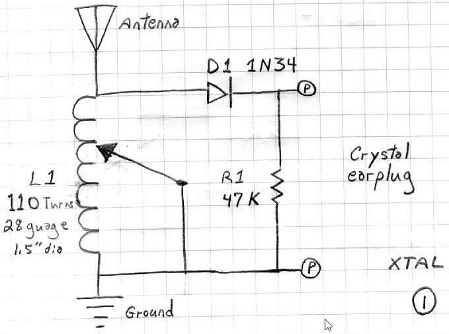
My 1st “electricity” was a science project… A “crystal radio” made with wood scraps, fine gauge lacquer insulated wire wrapped around a 6” length of 2×2, an IN34A diode, an inexpensive earpiece and a long wire for an antenna…and it worked.
As I slid the wiper arm from one end of the coil to the other, I could hear static through the earpiece…no battery or any other source of power, just the antenna. At several points I could hear voices and music, not real loud but discernable voices, sufficient to appreciate.
This triggered an intense curiosity, where was the electrical energy coming from that I could hear sound through an earpiece that belonged to a transistor radio that required a battery.
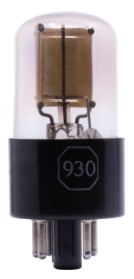
My 2nd electricity was another science project, “transmitting sound through a light beam” which I accomplished by attaching a light bulb and reflector from a flashlight to the two terminals on the disabled speaker of a radio providing a light source that was modulated with sound frequencies. I connected a photo diode (seen to the left) into the amplifier circuit of 1950s ear record player to convert the light energy back to sound energy…and it worked.
As I tuned the radio to different stations, the sound came from the record player, not the radio…nothing connecting them but light.
These were the childhood exposures that drove my imagination to devour any learning opportunity of electricity/electronics.
Young adult
I learned electronics in 1966 at the Marine Corps Recruit Depot in San Diego, vacuum tube and discrete transistor radio transmitters and receivers. In addition to being a ground pounder, I repaired radio equipment in Vietnam most of my time in country. When I was honorably discharged in 1970, I found employment as an electronics technician. Following positions with Singer-Friden, Picker X-Ray and Xerox as a field service engineer, I started a formal teaching career at an electronics school teaching a complete two-year electronic technology program. The school had a fixed curriculum, but I had the freedom to design my own lectures, training aids, quizzes and tests. In that era, alternative energy became a popular pursuit. I started teaching solar, wind, biomass and conservation at a college and in this situation, I created all my course materials. I designed and built solar control systems with relays for the logical control of fan motors and motorized dampers for air handling.
First Programmable Logic Controller
At a social event, a visitor from another state was looking through his briefcase and I noticed what I thought was a relay wiring diagram. Intrigued, I enquired and learned that it was a computer program, a ladder logic diagram for an Allen Bradley PLC.
I looked in the yellow pages for Allen Bradley and found the local AB distributor. I called and was granted a visit with a sales engineer and was allowed to watch some training videos on the PLC2 platform and write a program for one of their training units using the programming terminal of that day, a cathode ray tube programming terminal with interchangeable membrane keyboard.
Having developed many relay control systems, I was instantly hooked. I had hundreds of hours of firsthand experiential knowledge of the challenges of hardwired relay logic.
Career Path with Programmable Logic Controllers
Before the experience at the Allen Bradley was complete, I had realized an extreme affinity with this hardware platform. Within several weeks, I received an employment opportunity with Allen Bradley, with a choice of doing course development and course delivery for Programmable Logic Controllers (PLC) or Computerized Numerical Control (CNC). I chose CNC; I saw more opportunities in the market as an educator, specifically course development and delivery. The travel was the death of that opportunity, but I left with a lot of experiential knowledge of multi-axis motion control and Programmable Application Logic, a form of ladder logic diagrams specifically for handling the I/O (inputs and outputs) of a machine tool controlled by a computer, plus a lot of experience in course development. I developed a course for CNC and the Allen Bradley 8200 CNC platform.
An opportunity to design, build, program and commission a complete industrial control system found me. I learned enough previously about electrical control panels to design and build the panel and wrote the program. The process was a high vacuum deposition system making mirrored or aluminum coated products, glass of plastic.
Many opportunities found me, including some that afforded my learning AutoCAD and developing the skill of drafting electrical drawings and familiarity with the manufactures catalogs of all the components of industrial control systems. I was listed as an expert on the sensors used in these control systems and was a certified vision system integrator for a very popular vision system platform, hardware, lensing, lighting and software.
After dozens of engineering projects, I decided that I wanted to teach PLC Technology full time and another opportunity found me. The opportunity was with a major AB distributor as a technical specialist, primary responsible…teaching. For the next five years I developed and delivered technical courses for Rockwell Automation PLCs, HMIs and Networx solutions; to their customers.
The Story of the “PLC Professor” Learning Solutions
The Inspiration
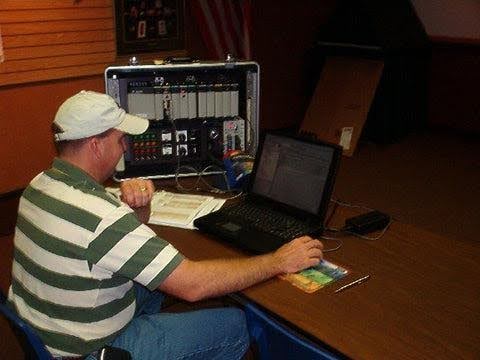
The seed for the “PLC Professor” was planted in 2003 with a colleague, Fred Rowe, my chief advocate, during my five years at Kendall Electric, a Rockwell Automation distributor based in southwestern Michigan. My responsibilities were the development of a PLC Programming Training Course for the Rockwell Automation (Allen Bradley) ControlLogix platform of controllers for live classroom delivery. Fred brought to my attention a market that was unaddressed, that of competent industrial electricians that were still building small relay panels for small projects. These projects were typically built with three plus relays that equaled and even exceeded the cost of a MicroLogix1000, a 1761-L10BXB. They needed the knowledge of PLCs as well as the ability to write simple ladder logic programs for the devices. This is where it started.
The Solution
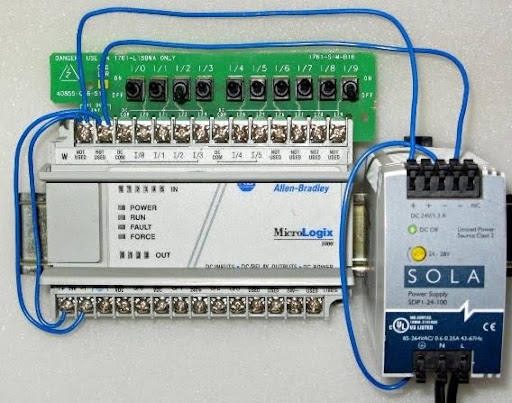
Fred assembled a dozen hardware trainers, 1761-L10BXB processors with a rail mount 24vdc power supply and a 1761-SIM-B16 (input simulator card). I stripped down the three-day PLC Programming Training Course for RSLogix500 to a one-day class that included both lectures and simple lab projects, including a garage door opener and a plant air compressor duty cycle control. The registration was free.
The first step in the class, that the customers, mostly electricians, wired the three components, 5 blue (DC) wires and a grounded power cord. We delivered the class several times; it was a real success with the customers. There were two options for the class, with or without taking the Micrologix1000 trainer home with them for further learning, a $90.00 investment in their future.
This was the beginning concept, hands-on, practical and…as free as we could make it.
With 8 hours available, there is no time for falderal, gee-gaws and theory, and we even provided complimentary coffee, water and doughnuts.
Time on My Hands – A rare opportunity to invest
In 2007, I step out of my technical career path in course development and teaching, sold everything and moved to the Dominican Republic to provide technical support and education to the children at a mission there. That area of the Dominican Republic is one of those places where a sense of urgency is unheard of, thereby yielding a lot of spare time. Needing productive projects for at least eight hours a day, I started to build on the idea of lab projects for the MicroLogix1000 10 point I/O controller. This would be a good controller for the public since, at the time, it was around $99 and the programming software was and still is free to the public.
Expanding the “Free” PLC Programming Training Course
I did not use any of the original lab projects used at Kendall Electric. Instead, I started from scratch with the commitment to deepen the learning experience for all hands-on project without a time restriction for the learners learning experience, working on their own on their schedule. and created lab projects for “The Five Originals”, XIC – XIO – OTE – OTL and OTU. Timer and counter instructions were addressed next because they represented the next level of simple instructions. With the completion of each lab, I looked for the next level of complexity. Eventually, I realized that I had projects for more than half of the 71 instructions supported by that processor, so why not just keep going until I had lab projects written for the entire instruction set.
During 2008, I created most of the “Complete PLCLearn Series” lab projects, offered 3 individual volumes and recorded a series of lab lecture/discussions that support all the learning experiences in that set of manuals. Most of this was accomplished during spare time at the mission in the Dominican Republic. The software used for recording was wanting and synchronizing the audio and video was often a challenge. In some of the videos recorded in the Dominican Republic, you can hear roosters crowing in the background. Eventually, a number of those videos were re-recorded, some discarded and the balance archived, although a few remain in playlists on YouTube. The three volumes, along with the recorded lectures and lab project discussions became my first PLC Programming Training Course.
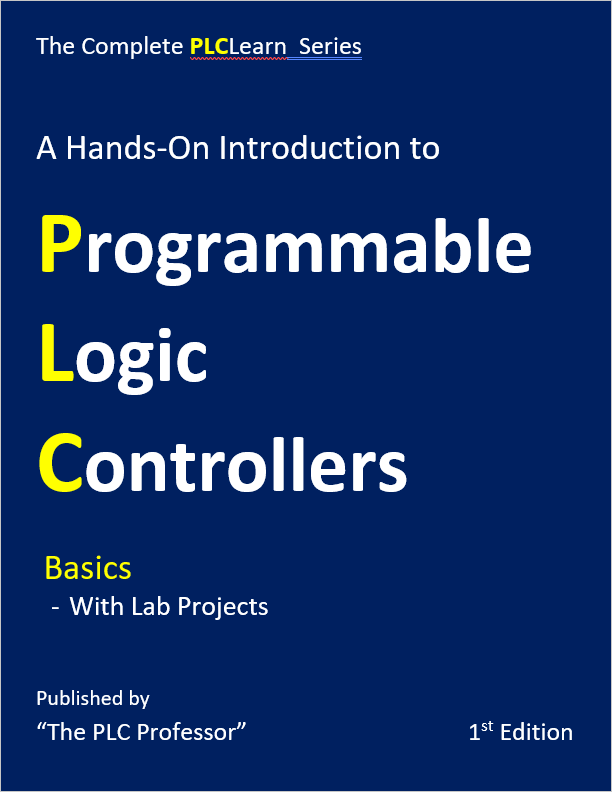
81 Pages
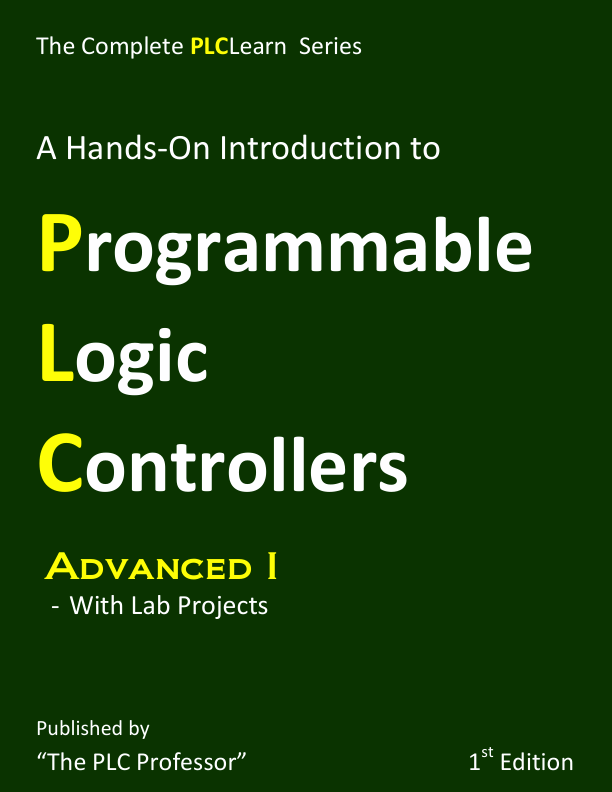
47 Pages
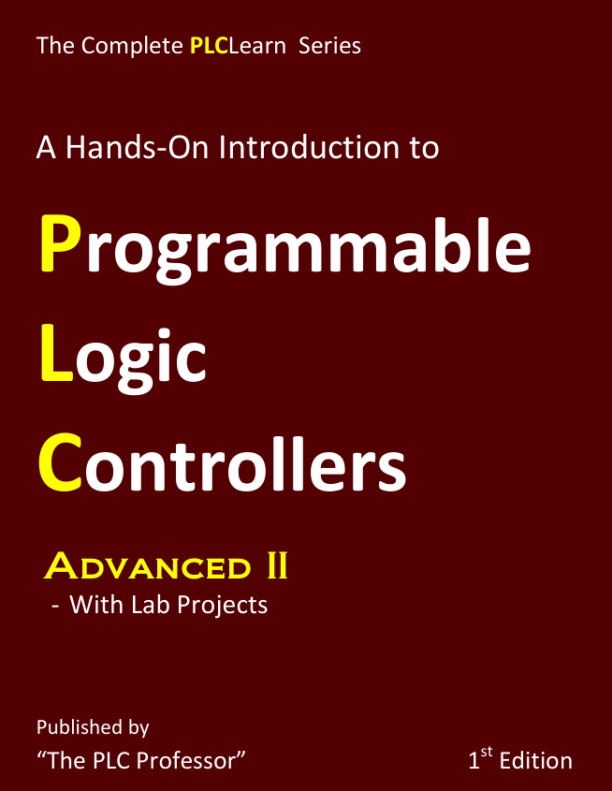
73 Pages
Prior to the creation of this PLC Programming Training Course, during my 15+ years as a live classroom teacher, I had integrated an incredible amount of feedback from students in a live classroom setting, editing my content and delivery after each classroom delivery.
The origin of the recorded lectures and lab discussions
The lab project manuals primarily provided step by step instructions to exercise the instruction set for a MicroLogix controller. They were created to be used in a setting where you exercise the concepts learned in lectures about programmable logic controller technology. In a conventional classroom setting, I would deliver lectures on that technology and then put the learners into hands-on lab time to exercise (demonstrate) the concepts from the previous lecture. I had hundreds of hours delivering lectures in a live classroom, I had all the lectures in my stored context, but I needed a vehicle to deliver them to distant learners. YouTube wasn’t even visible on the horizon then, but I knew that I could record them with Power Point (PPT) as narrations and that is where I started. I did not want PPT; I wanted recordings and PPT would record your voice discussing the slides. A short time into creating “slide show” with narration, I noticed the tools for animating slides and moved to narrated animated slide shows in PPT. Earlier in my career, I used Visio to create program flow diagrams. Visio provided some functions that were CAD-like, shapes and the ability to edit shape and color and visibility. These were the early recorded lectures…I attempted to market them on optical disks to no avail.
In early 2012, I received a witness in my spirit that I should upload them on YouTube, for free, rather than let the effort go to waste. Let someone get some benefit from hundreds of hours of labor.
In one year’s span, the view grew to almost 1600/day or 48K/mo. I was shocked and inspired to pursue this avenue more aggressively. One more year and the views grew to 3,342/day, approaching 100K/mo. This was an open market I had been blessed to wake up and find myself in that position.
I had already been using SnagIt for many years, and it was easy to stumble into Camtasia Studio, which I use to this day to record all my videos. It allowed me to use it as an “Add In” with PPT, or record directly from my screen image.
Once I had lab projects for the entire instruction set and general lectures on the technology that the lab projects would demonstrate, it occurred to me that I was missing the short discussions with Q&A that followed immediately after every lab session in the classroom. I had come this far, so why not keep going. I went through each lab project, one at a time, recording the results and discussing the implications until I had 40+ videos that covered all the lab projects. I literally learned how to create these videos as I went, each video was a little better than the last. If you have watched these early productions, then you have seen gradual improvement. It is unlikely that we will re-record all those early productions. Selling the lectures in disk sets was not successful so rather than having the effort go to waste, I uploaded them all onto YouTube, 60+ lectures uploaded in two days.
The evolution of the first PLC Programming Training Course
The original set of lab projects had been split into three volumes to reduce the cost of entry for learners. This was very inconvenient. This prompted combining all three volumes into one and each time I added more content, it resulted in a new edition eventually reaching 290 pages. Adding more content eventually required almost 500 pages to be split into two volumes, separating the lab projects into two logical groups.
The playlist of lectures on YouTube FREE – RSLOGIX500/MicroStarter Course that support this two volume set.
World Wide Web
Momentarily, a learner could watch all the videos free on YouTube, purchase an electronic PDF (no longer available) and complete the entire process for less than $25… anywhere in the world. In addition to Micro Starter Lite and RSLinx Lite, Rockwell has a version of 500 Emulate pro gratis; with these three applications, you can complete all of the labs in “The Complete PLCLearn Series”, with the exception of the message instructions, which requires two processors and, in some cases, a Net-AIC+ interface module. The PDF was eliminated when I found that one purchase a $25 turned into hundreds of users, human nature.
Even though I had 60+ videos on my YouTube channel, I found it frustrating trying to organize them in a way that made it easier for the learner to watch them in the proper order. I then created playlists and placed links on the website to those playlists and still the learners wandered around YouTube, looking for the next video in the sequence. I needed to be a classroom with a fixed boundary. I knew that the additional content was available on the web, but I also knew that it was not easy for the new learner to find the content, much less discern between the “Good, the Bad and the Ugly”. My solution was to provide a website structured to marshal all the necessary content at a central location, organizing it into classrooms. My first goal was to add the PLC Professor content and then create the additional classrooms for many other subjects, including math, physics, English and even art with an industrial flavor. This is the PLC eUniversity.
With a lot of experience, both teaching RSLogix/Studio5000 and using it in the field as an industrial controls engineer, I decided to repeat the development process I had just learned the hard way, but with ControlLogix/CompactLogix, or rather the “Logix Engine”. This effort placed the first lab project manual on the shelves in the university bookstore with an accompanying video lecture/discussion disk set.
A Change of Venue
IN 2007, I PURGED MYSELF OF ALL POSSESSIONS, SAVE A HALF DOZEN PLASTIC TUBS OF “STUFF” AND MOVED TO THE DOMINICAN REPUBLIC. THE PROCESS LEADING UP TO THIS MOVE WAS SIMPLE: MAKE UP YOUR MIND (Commit), MAKE A PLAN AND EXECUTE THE PLAN.
STEP ONE WAS GETTING TOTALLY OUT OF DEBT:
- I created a spreadsheet with all my debts in horizontal rows, with columns that represented successive months (payments).
- The first column was the running balance of each debt, the value shrinking with each monthly payment.
- The largest debt occupied the top row and the smallest debt the bottom row on the spreadsheet.
- As each of the smaller debts was paid off, the payment amount was assigned to the debt above on the spreadsheet, or what was now the smallest debt. This was done to accelerate the payoff date.
- Additional columns to the right to reflect future results to provide an incentive to stick to the plan. Within 18 months, I was debt free.
STEP TWO WAS PURGING MYSELF OF POSSESSIONS.
Possessions tend to dis-possess you emotionally and spiritually. I had closets, a basement and a garage full of things that I had purchased to self-medicate. Even though I was participating in many charitable events, it was not enough. I found several pairs of slacks in my closest with the store tags still attached… never worn. That is just one example of things that I thought that I needed and yet lost track of them in a mass of “things”.
- Find possessions to put on eBay. You would be surprised what will sell on eBay.
- What I could not sell, I gave away.
- For the items that I could not find a person/organization to accept for free, I rented a large dumpster and filled it to the brim with them.
- As the basement, garage and closet began to empty, I felt a tremendous sensation of lightness and freedom. I was repossessing my life.
STEP THREE WAS PREPARING A PLACE TO LIVE IN THE DOMINICAN REPUBLIC.
I purposed to join a friend, who grew up there, who started a mission for children in the foothills of the mountains west of Santo Domingo; I started saving to build a habitation in that locale.
I sold a late model Dodge minivan that was my work vehicle and a mint 2000 Jeep Wrangler Sahara, this paid for my apartment and the purchase of my first avocado plantation (300 trees). Left the U.S.A. for the Dominican Republic houseless, without a vehicle and added my technical skill set to the staff at the mission and began designing buildings, teaching computer classes and redesigning Pinewood Derby to accommodate the local resources (no tech instead of high tech). I designed and built LED lighting structures for the church stage that serve the same purpose as areas of fabric illuminated by spotlights.